Is AI Voice Cloning Legal? What Creators Need to Know in 2026
· 13 min read
Yes, AI voice cloning stays legal in most places when you clone your own voice or get explicit, documented permission for someone else's. The key is never using it to deceive. It turns illegal if you copy a voice without consent for commercial gain, use it for fraud, or skip required disclosures like the EU AI Act's synthetic-audio labeling rule that started in August 2026.
For creators, the safest move is cloning only your own voice inside one controlled workflow. That is why I recommend Cliptalk: you clone your voice once and use it directly in finished, captioned short-form videos, so your voice model doesn't sit in a pile of standalone tools you can't keep track of.
The rest of this guide breaks down what decides if a cloned voice is legal, the laws that shifted from 2024 to 2026, and the checks I run before publishing anything with a synthetic voice. This is practical guidance from a creator, not legal advice. If you're signing a voice deal or building a commercial product on someone else's voice, talk to a lawyer in your jurisdiction.
The short version: what makes a cloned voice legal or illegal
The technology itself is not illegal. Your legal risk comes from three things: whose voice it is, what you do with it, and whether your audience is misled.
| Scenario | Risk level | Why |
|---|---|---|
| Cloning your own voice for your own channel | Low | You own your identity and can consent to its use |
| Cloning a voice actor's voice with a signed, specific release | Low | Consent is documented and scoped |
| Cloning a friend's voice "because they said it was fine" | Medium | Verbal consent is hard to prove and rarely covers commercial use |
| A "sound-alike" of a famous person in an ad or sponsored video | High | Right of publicity claims, even without using their actual recordings |
| Recreating a deceased performer's voice for commercial content | High | New York now requires prior consent from heirs |
| Cloning anyone's voice to trick people into paying, voting, or sharing data | Illegal | Fraud and impersonation laws apply regardless of the tool |
| Undisclosed synthetic voice in content distributed in the EU | High | The EU AI Act labeling rule applies from August 2026 |
When creators ask me whether AI voice cloning is legal, they usually mean the first two rows. Those stay low-risk if you handle consent and disclosure properly. Most of the trouble sits in the middle rows, where people assume they are covered and they are not.
Copyright doesn't protect a voice, but the right of publicity does
Copyright is the most common source of confusion, and it works differently than most creators expect.
A raw AI-generated voice file generally can't be copyrighted. The U.S. Copyright Office requires a human author. When you type a script and the model makes every performance choice (pitch, pacing, breath, emphasis), the machine did the creative work. In practice, a purely AI-generated voiceover has very weak ownership protection. Someone else could reuse that exact audio and you'd have a hard time stopping them.
What protects you, and what can be used against you, is the right of publicity. Copyright treats creative works as property. The right of publicity treats your identity (your name, face, and in many states your voice) as something you control for commercial use.
This rule isn't new. Courts drew the line in the 1980s:
- Bette Midler sued Ford after the company used a sound-alike singer in a car commercial.
- Tom Waits sued Frito-Lay over a similar imitation of his distinctive voice in advertising.
Neither case involved AI or the singer's actual recordings. The imitation alone was enough. AI cloning simply makes this kind of imitation faster, cheaper, and more convincing. If a "celebrity-style" voice in your sponsored Short is good enough that viewers think it's the real person, you are in the same legal territory those cases covered.
The takeaway for creators is simple. Don't count on copyright to protect your AI voiceovers, and don't assume the absence of copyright makes someone else's voice free to use.
The laws that changed the picture in 2024 to 2026
Voice-specific laws have arrived quickly. These are the ones I watch most closely as a creator.
Tennessee's ELVIS Act
The Ensuring Likeness Voice and Image Security Act was signed on March 21, 2024, and took effect on July 1, 2024. It amended Tennessee's right-of-publicity statute to explicitly protect a person's voice from AI cloning.
The key detail is who it targets. The Act creates a cause of action against anyone who distributes a technology whose "primary purpose or function" is creating an unauthorized facsimile of a person's voice. Tool providers can be liable, not just the person who pressed "generate." Expect platforms to tighten their consent checks in response, which helps everyone using them legitimately.
New York's 2025 laws
In December 2025, Governor Hochul signed two laws that matter to creators:
- Synthetic performer disclosure in ads. Commercial advertisements that use AI-generated "synthetic performers" must disclose it. This took effect in June 2026. If you produce sponsored content with an AI voice or AI character, this is directly relevant.
- Posthumous right of publicity. Commercial use of a deceased person's name, voice, image, or likeness now requires prior consent from their heirs, and this explicitly covers AI "digital replicas."
That second law addresses exactly the situation Zelda Williams described in 2023, when she called AI recreations of her father, Robin Williams, "personally disturbing." The "tribute" voice of a late celebrity in a monetized video is no longer a gray area in New York.
The EU AI Act's synthetic audio labeling
The EU AI Act's rule on labeling synthetic audio took effect in August 2026. If your content reaches European audiences, which is true of almost any TikTok, Shorts, or Reels account, you should treat clear disclosure of AI-generated voice as a baseline requirement.
Biometric privacy lawsuits
Your voiceprint is biometric data. In May 2026, nine biometric-privacy class actions were filed in connection with voice cloning. For creators, the lesson is that collecting other people's voice samples, for example by running a "send me a voice note and I'll clone you" engagement campaign, carries real data-handling risk beyond the right of publicity.
Fraud and impersonation: where cloning becomes a crime
The points above fall under civil law, where you might face lawsuits, pay damages, or see your video removed. Fraud moves into criminal territory, and that is where voice cloning has caused the most damage.
The numbers stand out. One in 10 Americans say they have dealt with a voice-clone scam, based on CNN reporting from May 2026. McAfee showed that just three seconds of audio can create an 85% voice match. Any creator posting talking videos has shared far more than three seconds.
Two well-known cases illustrate the range:
- January 2024: A robocall using an AI clone of President Joe Biden's voice told New Hampshire residents not to vote in the primary. Election interference with a cloned voice draws one of the clearest lines.
- Jeff Geerling, the YouTuber, publicly called out a company that cloned his voice without permission to promote its products. That case centers on commercial misappropriation aimed at a creator.
No tool or terms of service protects you when the goal is deception. Impersonating someone to obtain money, votes, credentials, or endorsements is illegal, whether you use AI, a sound-alike actor, or your own impression.
The risk runs both ways. As a creator, you are also a potential target. Here are a few habits that help:
- Agree on a "safe word" with family and close collaborators for urgent voice or phone requests.
- Never verify payments, brand deals, or account changes based on a voice message alone.
- Keep your original voice-training recordings private. Do not upload them to random free apps that promise to "clone anyone from a voice message."
What real consent looks like
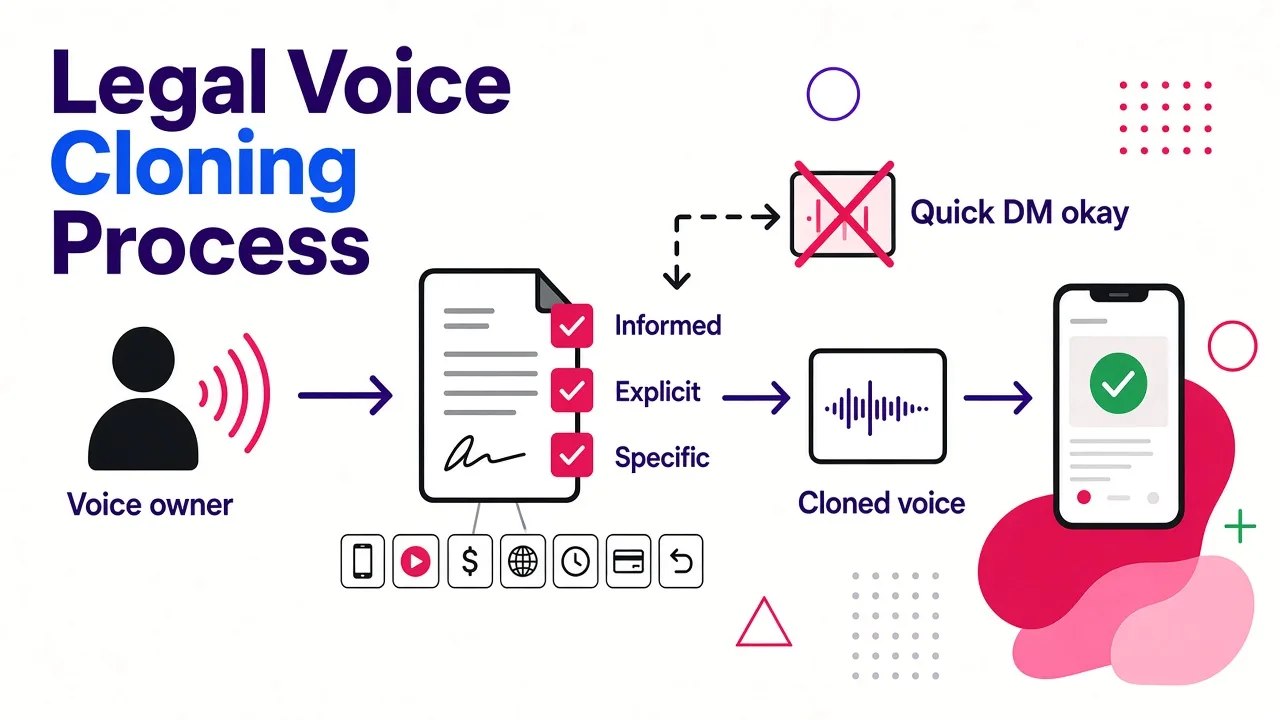
Consent forms the base of legal voice cloning. It is also the spot where most creators skip details. A quick "sure, go for it" from a friend in a DM does not count as a release.
Solid consent needs three traits:
- Informed: The person understands exactly how the clone will be used, on which platforms, and for how long.
- Explicit: A clear opt-in step, like a signed document. Skip pre-checked boxes and assumptions.
- Specific: Permission to clone a voice for an internal training video does not extend to a paid national ad campaign. The scope counts.
When I work with another voice, whether a co-host, hired narrator, or client, I write down these points:
- Whose voice is being cloned and confirmation that they own it.
- Which platform or tool will host the voice model.
- The exact content types allowed, such as organic videos, ads, or sponsored posts.
- Whether commercial use is permitted and in which regions.
- How long the permission lasts and what happens to the voice model at the end.
- Any payment or compensation terms.
- The right to revoke and the timeline for removing content if they do.
AI voice output is difficult to copyright. This contract often becomes the only way to secure an exclusive, defensible right to use that voice. It safeguards both the voice owner and you.
Platform rules: disclosure on TikTok, Shorts, and Reels
Even when your use is legal, the platforms set their own rules. Those rules decide whether your video stays up and keeps earning.
TikTok, YouTube, and Instagram follow the same pattern: label realistic synthetic or altered content that could mislead viewers with the platform's AI disclosure tools, and never impersonate real people. Cloning your own voice to narrate a faceless explainer usually stays low risk. Cloning a public figure to say something they never said gets taken down.
YouTube adds another layer for monetization. Channels that rely on fully synthetic, repetitive narration often run into reused or low-effort content flags. I covered how to keep cloned voices compliant in how to use voice cloning for YouTube videos and stay monetized.
My rule is simple. If a viewer could reasonably believe a real, identifiable person is speaking when they are not, I add the label. Even when the voice is my own clone reading my own script, I still use the platform's AI label if the result sounds realistic. It takes almost no effort and removes an entire category of risk.
Choosing a tool with legal risk in mind
Your choice of tool affects your legal exposure more than most creators expect. After testing dozens of these products, I group them into three categories based on how they handle voice models day to day:
- Embedded voice cloning inside a video workflow (Cliptalk): You clone a voice and drop it straight into finished videos that already include captions and B-roll. The model stays inside your account and tied to your own content, so tracking its use stays simple.
- Standalone voice cloning tools: These export audio files or API output. They work well for long narration or dubbing, yet the files then move through editors, drives, and collaborators, which makes control harder.
- Open-source and self-hosted models: You gain full control and lower cost, but consent rests entirely on you. Nothing prevents you or anyone with access to your machine from cloning a voice without permission.
Before you upload even one sample, check these four points:
- Consent verification. Many tools ask only for a checkbox at sign-up. One independent review dropped every provider whose enforcement stopped at that checkbox. A box does not protect you; your own written consent does.
- Watermarking and detection. Some enterprise platforms add audio watermarking and deepfake detection. These features make any misuse easier to trace back.
- Commercial rights by plan. Free tiers often exclude commercial use. If you plan to monetize, confirm the plan covers it.
- Vendor stability. PlayHT shut down permanently on December 31, 2025, after Meta acquihired its team. When your model lives with one provider, keep your original clean recordings and consent paperwork so you can rebuild elsewhere.
If you want the full breakdown on sample rules, quality levels, and pricing, the complete guide to voice cloning software in 2026 covers every option.
How I use voice cloning safely in Cliptalk
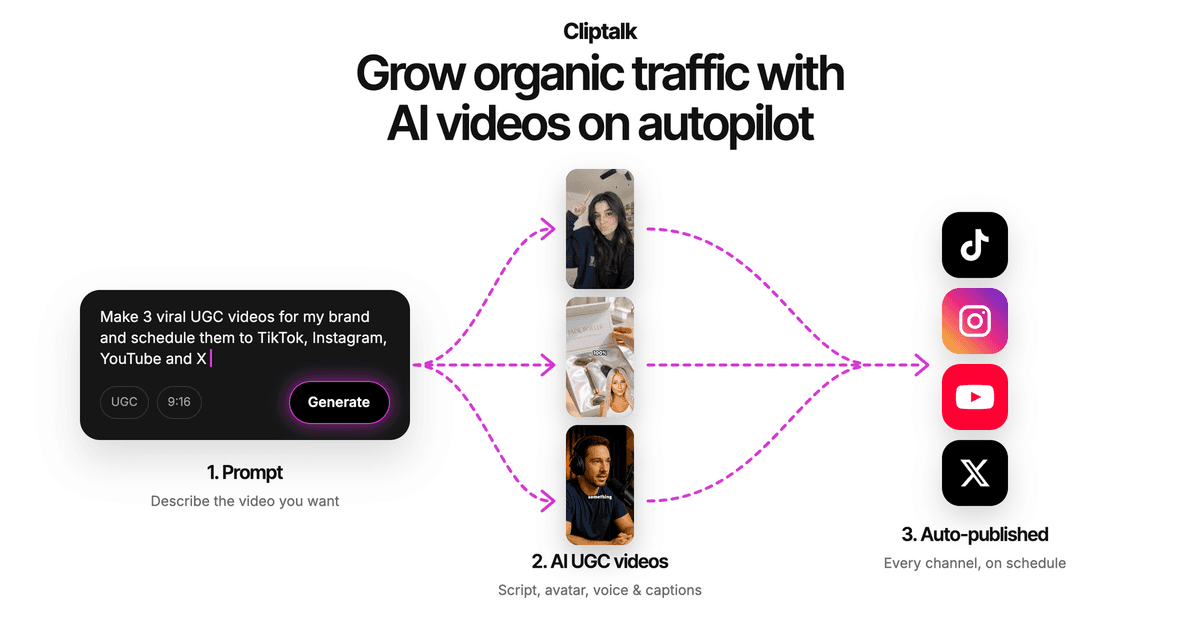
My setup stays simple on purpose, since simple choices reduce legal risk. I clone only my own voice from a clean sample recorded in a quiet room. Quick clones can start with just a few seconds of audio, but 20 to 30 seconds of clear speech produces steadier results. I store the original file offline as a backup.
Cliptalk then does the heavy lifting. I drop in a script or article, and the tool outputs a finished short that includes my cloned voiceover, automatic captions, and matching B-roll. Since the voice stays inside my projects only, I always track where it is used and avoid handing out raw files.
When a script needs a different voice, I skip cloning real people. Instead I pick a stock AI voice or an AI character. These options carry no right-of-publicity concerns and remove the need for consent paperwork on projects that do not require a specific person's voice.
My pre-publish checklist
Before any video with a cloned or synthetic voice goes live, I run through this:
- Whose voice is this? Mine, a stock AI voice, or a person with a signed release. If it's none of those, it doesn't ship.
- Does the release cover this use? Check the platform, the content type, commercial use, and the region.
- Could a viewer think a real, identifiable person said this? If yes, disclose it, or rewrite the content.
- Is it an ad or sponsored post? If so, add an explicit synthetic performer disclosure, especially for New York audiences.
- Will it reach EU viewers? Assume yes and label the synthetic audio.
- Does it reference a real person in a misleading way? Fake endorsements, fake quotes, and fake "leaked" audio are off the table.
- Is it a deceased person's voice? Without heir consent, don't use it commercially.
- Did I turn on the platform's AI label where the voice is realistic?
- Are my original voice recordings and consent documents stored safely outside the tool?
Running this checklist takes about two minutes per video. It is the cheapest legal insurance a faceless channel can buy.
Frequently asked questions
Is it legal to clone my own voice?
Yes. Cloning your own voice for your own content carries the lowest risk. You still need to handle platform disclosure for realistic audio and follow AI labeling rules in regions like the EU.
Can I clone a celebrity's voice for parody or commentary?
This is risky and depends on the jurisdiction. Parody and commentary receive some protection, yet the Midler and Waits cases show that commercial sound-alikes create problems even without the original recordings. Laws such as Tennessee's ELVIS Act directly target unauthorized voice copies. Avoid it if the video is monetized, sponsored, or could pass for the real person.
Can I own the copyright to an AI voiceover I generated?
Usually not for the raw audio, since the U.S. Copyright Office requires human authorship. Your script, edits, and overall video can still reflect human authorship. The real value of a specific voice sits in contracts and the right of publicity, not copyright.
Do I have to disclose that I used an AI voice?
Increasingly, yes. The EU AI Act's synthetic audio rules apply from August 2026, New York requires disclosure of synthetic performers in ads from June 2026, and TikTok, YouTube, and Instagram expect labels on realistic synthetic content. Disclosure remains the safe default.
Can a friend give me permission over text?
It beats having nothing, but the evidence stays weak and rarely covers every detail. Use a short written release that lists the purpose, platforms, commercial use, duration, and revocation rights. That document protects both sides if issues arise later.
What should I do if someone clones my voice?
Save the evidence with links, downloads, and timestamps. Report the content to the platform under its impersonation or synthetic media policy, and alert your audience if the clone appears in sales or scams. Commercial misuse may support a right-of-publicity claim, especially in states like Tennessee and New York that now name voice and digital replicas explicitly.
AI voice cloning is a legitimate, powerful tool for creators, and in 2026 the rules sit clearer than ever: use your own voice or a properly licensed one, disclose realistic audio, and never deploy it to deceive. Stick to those three rules and voice cloning simply becomes a way to publish more without hours in front of a microphone.
Tags: ai voice cloning, creator legal basics, right of publicity, ai disclosure, faceless channels